
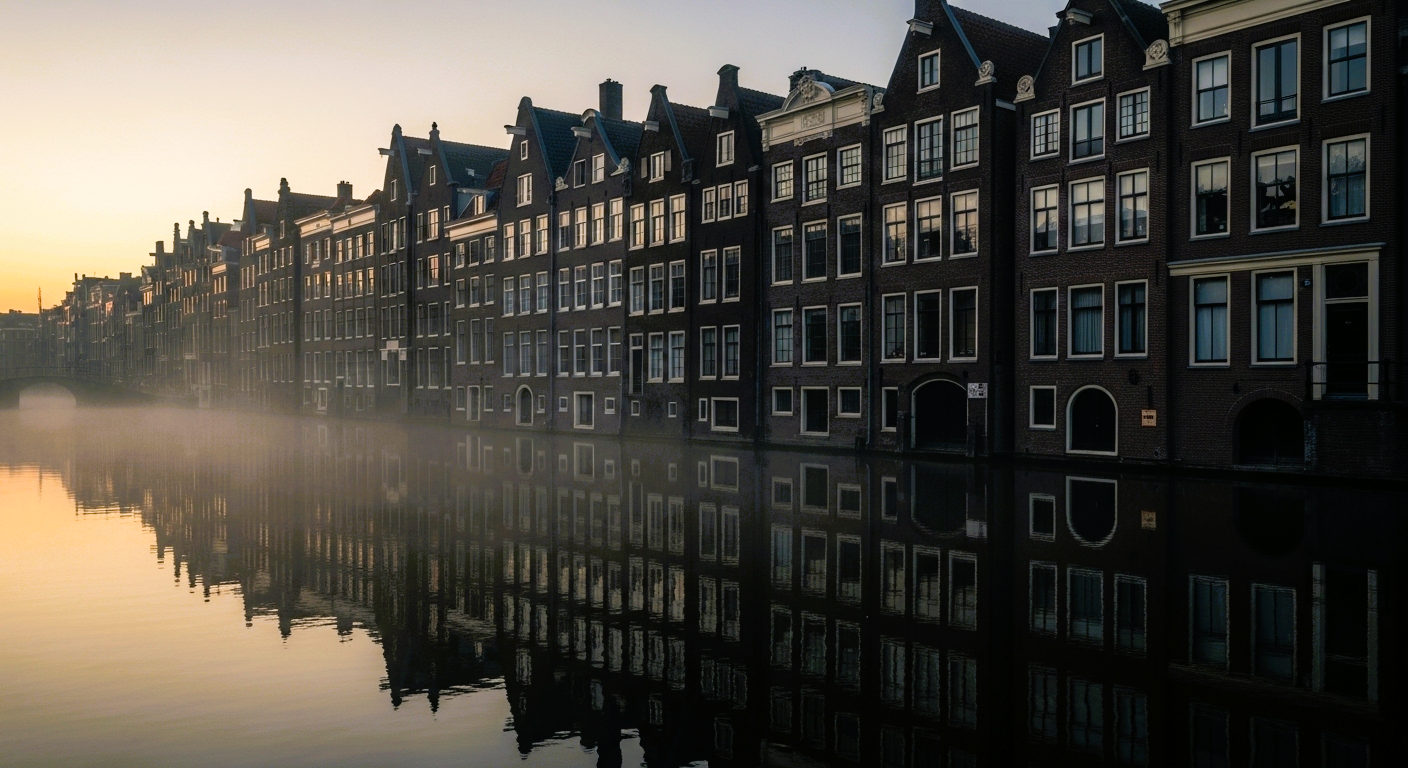
To observe Amsterdam is to witness a delicate negotiation between the liquid and the stone. It is a city that does not merely sit upon the land but floats within a rhythmic pulse of historic engineering and golden-age ambition. Here, the concept of unhurried travel is not a choice but a requirement, dictated by the narrow brick corridors and the leaning facades that whisper of a century’s weight. The city functions as a curated gallery where the exhibits are the houses themselves, their gables reaching like hands toward a gray, maritime sky. To walk these streets is to engage with a living philosophy of observation, where every reflection in the dark canal water serves as a secondary, shimmering reality of a society built on the art of the intentional.
The Geometry of the Amstel
The Amstel River acts as the foundational spine of Amsterdam, a liquid avenue that dictates the mathematical precision of the city’s concentric growth. To observe the river is to understand the Dutch mastery over the ephemeral; it is a landscape defined by the rhythmic repetition of stone bridges and the stoic permanence of the quay. This waterway is not merely a topographical feature but a curated vista where the architecture leans inward, as if paying homage to the source of its prosperity. The grand facades along the riverbanks serve as a visual lexicon of the Golden Age, where symmetry and proportion reflect a societal obsession with order and aesthetic clarity. In the stillness of a slow afternoon, the river transforms into a vast, horizontal gallery, framing the city’s evolution from a tactical fishing outpost to a sophisticated metropolitan masterpiece of maritime engineering.
The Interiority of Light
In the Dutch tradition, light is treated as a physical substance, a tactile element that defines the soul of a space. This philosophy is most evident when observing the interplay between the tall, narrow windows of the canal houses and the shifting northern sky. The architecture is designed to invite the sun’s reach deep into the domestic sphere, creating a dialogue between the public facade and the private sanctuary. This curation of light traces back to the canvases of the Old Masters, where a single source of illumination could transform a mundane room into a spiritual encounter. To wander the streets is to notice how the glass panes act as filters, catching the silver glint of the clouds and casting a soft, painterly glow upon the weathered textures of the interior timbers. It is an invitation to pause and acknowledge the quiet, luminous poetry inherent in the city’s very atmosphere.
The Industrial Rebirth of the North
To cross the water toward the northern banks is to transition from the golden-age past into a landscape of metallic reclamation. The ritual here is one of vertical observation, where the skeletal remains of shipyards have been repurposed into a new, jagged aesthetic. This industrial rebirth demands a different pace—one that appreciates the rusted patina of a crane against the stark, modern glass of a museum. It is a dialogue between the obsolete and the avant-garde, where the echoes of heavy machinery have been replaced by the quiet hum of creative intention. One must stand at the edge of the NDSM wharf and allow the scale of the repurposed hangars to dwarf the senses, acknowledging how the city breathes through its ability to reinvent its own iron bones into a contemporary masterpiece of urban survival.
The Silent Gardens of the Begijnhof
Engaging with the hidden interiority of the city requires the unhurried method of seeking the void. The Begijnhof represents a physical pause in the urban fabric, a sanctuary of medieval silence tucked behind an unassuming wooden door. To enter this space is to step out of the chronological flow of the surrounding streets and into a curated stillness. The observation here is found in the soft alignment of the small, white-painted facades and the ancient, tilted gravestones set into the lawn. It is a masterclass in the art of the enclosed garden, where the architecture acts as a dampener for the external world. The nuance lies in the sound of one’s own footsteps on the cobblestones, a rhythmic reminder that the most profound artistic experiences in Amsterdam are often those found in the deliberate absence of noise.
The Perennial Gallery of the Lowlands
Amsterdam remains a testament to the endurance of the human scale in architecture. It is a city that refuses to be consumed by the velocity of the modern era, instead inviting the observer to synchronize their pulse with the slow lap of the canals against the quay. Its artistic legacy is not confined to the gilded frames of its museums but is etched into the very grain of its brickwork and the specific, silver quality of its light. To leave Amsterdam is not to exit a destination, but to step out of a meticulously curated experience of space and time, where the dialogue between history and innovation continues to resonate in every silent, gabled reflection.
As the light fades over the Amstel, one must consider where the next conversation between the environment and the soul will begin, perhaps in the layered shadows of another historic capital awaiting a similar unhurried gaze.
Leave a Reply