
Milan does not perform for the casual observer; it reveals itself in the measured pace of those who understand that beauty is often found behind heavy iron gates and within the rhythmic geometry of stone. It is a city of layers, where the industrial grit of the Navigli meets the celestial ambition of the Duomo, creating a tension that defines the Italian modern spirit. To walk through Milan is to participate in a slow unveiling of architectural intent, a movement through space where light transforms cold marble into a warm, tactile history. Here, the philosophy of observation demands a stillness that contradicts the city’s reputation for speed, inviting a profound engagement with the aesthetic soul of Lombardy’s silent protagonist.
The Echo of Spires and the Geometry of Faith
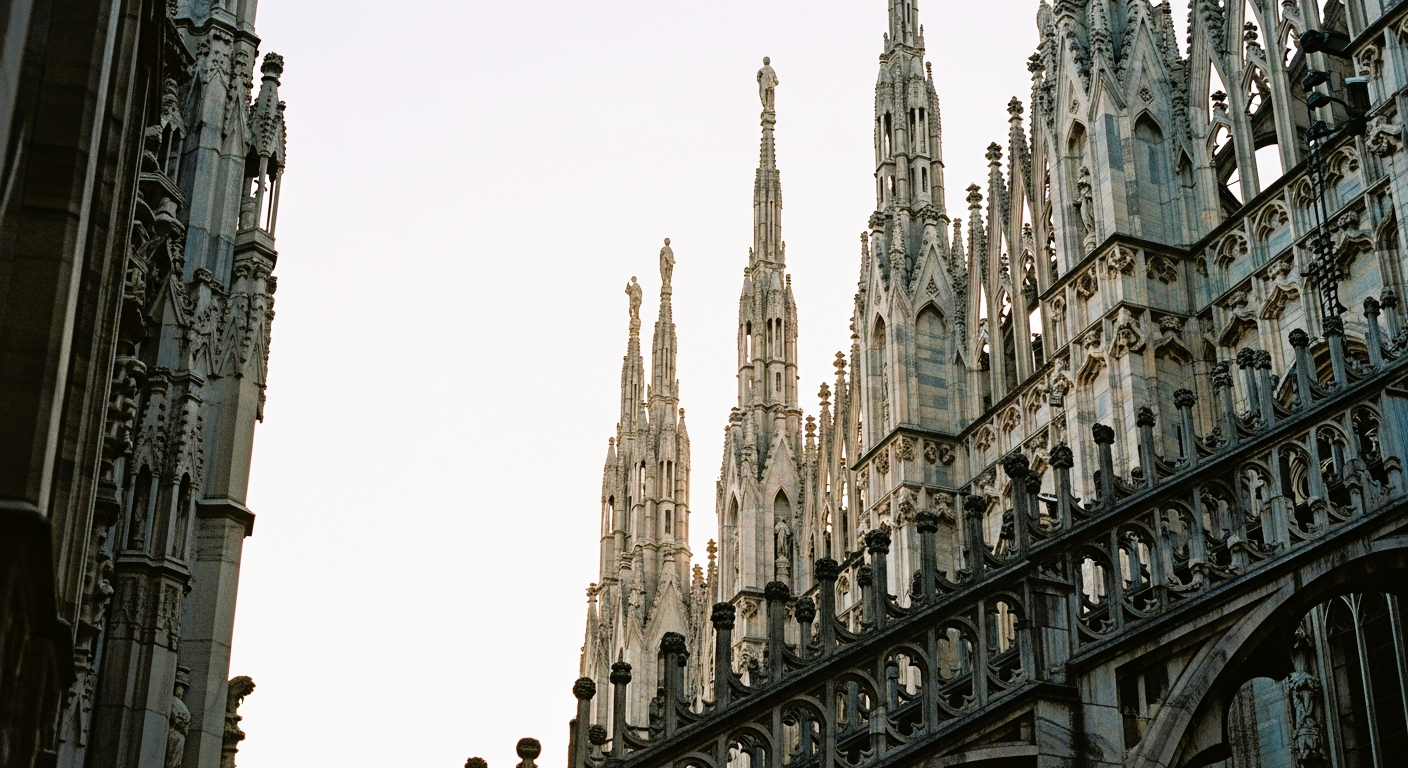
The Duomo di Milano stands not merely as a cathedral but as a perpetual act of devotion carved from Candoglia marble, a pink hued stone that seems to inhale the soft Lombard sun. To observe it slowly is to understand the terrifying ambition of the Gothic mind, where thousands of pinnacles and statues do not clutter but harmonize, creating a forest of stone that strives relentlessly upward. It is a masterclass in the geometry of faith, where every rib vault and flying buttress serves a dual purpose: structural necessity and theological expression. Inside, the dim light filters through massive stained glass cycles, illuminating the wear on the ancient floor and casting complex patterns that shift with the hours. The complexity demands a lingering gaze, rejecting the quick snapshot for a deeper contemplation of how such delicate detail can support such monumental weight, a silent conversation between human craft and divine aspiration.
Rationalist Shadows and the Modernist Whisper
Milan’s soul is equally defined by the stern grace of the 20th century, a stark counterpoint to the medieval spire. The Rationalist movement, which flourished here, sought to scrub architecture of ornament, finding beauty instead in pure form, rhythmic repetition, and functional integrity. This aesthetic is not cold but profoundly cerebral, demanding an unhurried appreciation of volume and shadow. Consider the Torre Velasca, a polarizing concrete interpretation of a medieval watchtower, or the clean lines of the buildings surrounding Piazza Diaz. These structures represent a cultural shift towards modernity and efficiency, mirroring Milan’s post war industrial resurgence. They are whispers of a pragmatic yet artistic mindset, where the play of light on smooth, unadorned surfaces creates a minimalist poetry. To observe these structures is to witness the architectural manifestation of Milanese reserve—a quiet, confident rejection of the superfluous in favor of structured intent
The Secret Thresholds of the Brera Courtyards
To engage with Milan is to master the art of the threshold, particularly within the Brera district where the city’s heart beats behind heavy timber doors. One must pause at these entries, waiting for the momentary opening that reveals a hidden universe of neoclassical columns and cascading ivy. These courtyards are silent galleries of the domestic and the academic, where the sound of the street fades into a rhythmic drip of a central fountain or the muted scrape of a gardener’s tool. Observing these spaces requires a lingering presence, a refusal to rush past the glimpses of moss covered statuary and gravel paths. It is a ritual of discovery, where the boundary between public ambition and private sanctuary dissolves into an intimate architectural embrace.
Industrial Metamorphosis along the Naviglio Grande
The Naviglio Grande offers a different tempo, a horizontal stretch of water that reflects the city’s utilitarian origins and its artistic rebirth. An unhurried exploration here involves watching the play of light upon the canal’s surface as it ripples against the ancient, moss slicked stone embankments. The iron bridges, with their intricate lattice work, serve as vantage points for observing the slow transformation of the industrial landscape into a sanctuary for the bohemian spirit. One should focus on the textures of the peeling plaster on the surrounding Case di Ringhiera, noting how the reflections of ochre and terracotta dance in the slow moving current. It is a study in decay and renewal, where the water acts as a rhythmic metronome for a city that never truly stops evolving.
The Lasting Resonance of an Observed City
To leave Milan is not to finish a visit, but to carry forward a refined methodology of seeing. The city’s profound artifact is not any single painting or building, but the enduring, dynamic tension between its vertical Gothic ambition and the severe horizontal logic of its modernism. It is a metropolis that deliberately rewards the patient curator of moments, those willing to seek the profound silence nestled within its industrial noise. Milan teaches us that the greatest masterpieces are often the ones we live within, found in the threshold of a hidden courtyard, the precise angle of a rationalist shadow, or the reflection of history upon a canal’s surface.
Having absorbed the curated quietude of Lombardy’s capital, we prepare to shift our gaze. Our next exploration will dismantle the myths of another legendary landscape, seeking the artistic intent hidden beneath layers of perceived chaos and light, continuing this necessary discipline of unhurried observation.
Leave a Reply