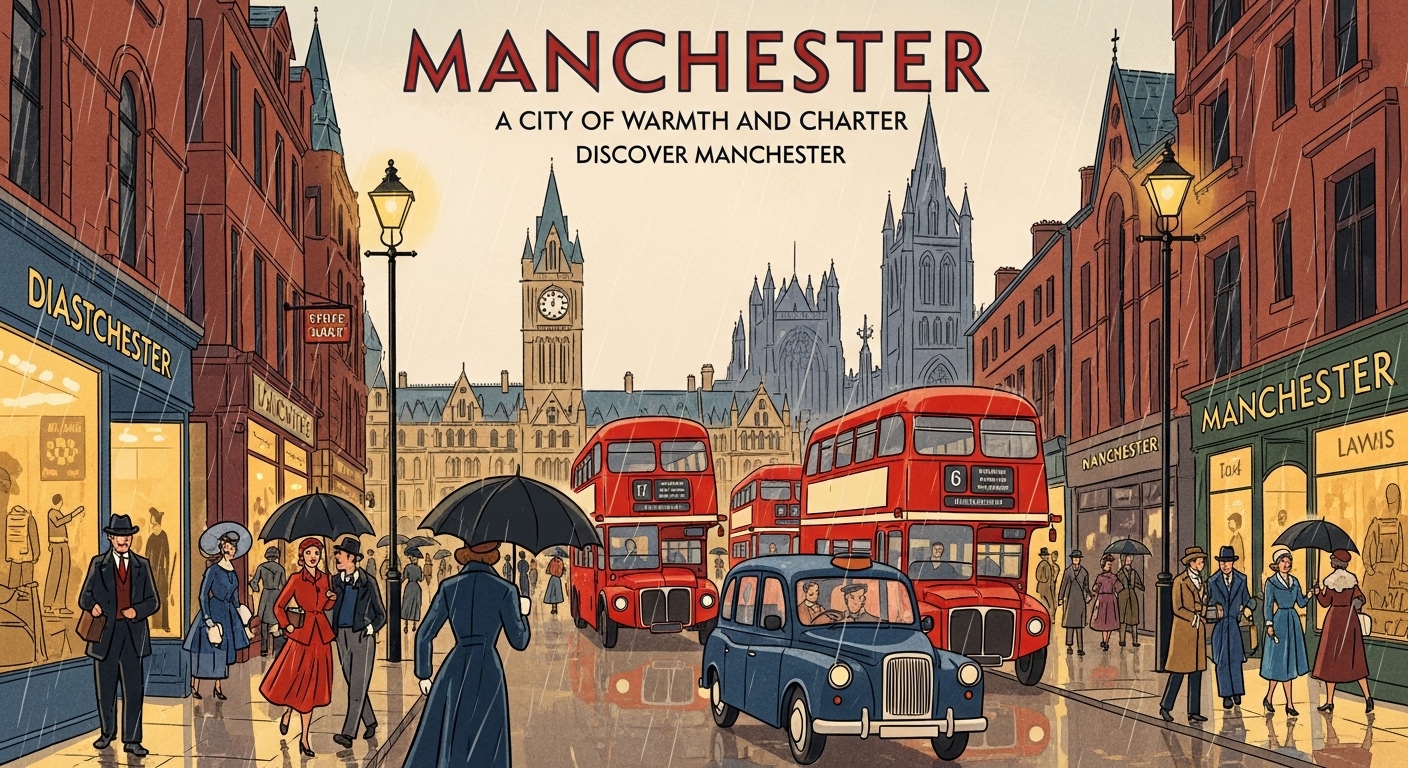
Manchester is a city that rewards the patient observer. Beyond its reputation for industrious bustle and iconic music, there is a rhythmic, quiet soul found in the reflection of a canal or the steam rising in a Northern Quarter cafe. This collection is designed for the “unhurried traveler” those who seek to carry a piece of Manchester’s understated elegance wherever they go.
The Slow Pour
Watch the world drift by through a steam-fogged window in this quiet tribute to the city’s coffee culture. Let this Manchester Wallpaper bring a sense of morning stillness to your digital space.
Guardian of the Square
There is a timeless gravity in the stone spires that have watched over the city’s heart for generations. This Manchester Wallpaper captures the grand, unhurried pace of history.
The Secret Corridor
Wander away from the main thoroughfare to find the quiet rhythm of the historic brickwork. This Manchester Wallpaper celebrates the beauty found in the city’s hidden architectural corners.
A Sky of Cotton and Steel
As the day fades, the city transforms into a gentle tapestry of light and shadow. Carry the calm of the evening horizon with you through this Manchester Wallpaper.
The Rhythmic Metrolink
Journey across the city at a pace that allows you to notice every detail. This Manchester Wallpaper honors the steady, rhythmic pulse of the city’s iconic yellow tram.
Still Waters of the Basin
Find a moment of absolute serenity where the canal water meets the industrial soul of the city. This Manchester Wallpaper serves as a digital sanctuary for the weary traveler.
Manchester’s eating rhythm is built around hearty midday sustenance and late evening gatherings. Locals lean into pub culture, where food is paired with ale and conversation, while tourists often misstep by chasing breakfast trends or expecting fine dining at every turn. The city thrives on honest portions and communal tables, and visitors who skip the pubs or arrive too early for dinner miss the pulse of how Mancunians actually eat.
Lancashire Hotpot – The warmth of working class tables
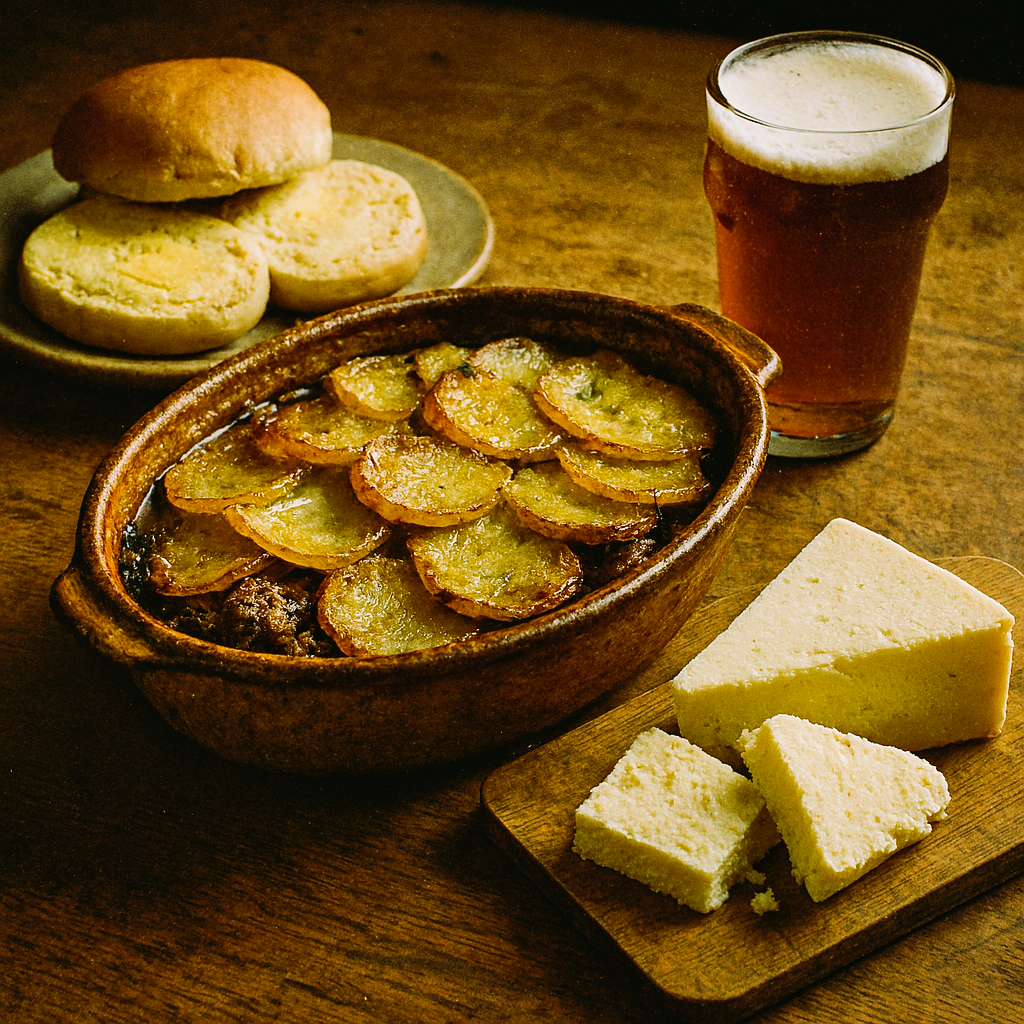
The hotpot is Manchester’s anchor dish, a slow baked stew of lamb, onions, and sliced potatoes layered in a heavy ceramic pot. Its flavor is earthy and sustaining, the kind of meal that once carried mill workers through long shifts. The texture shifts between tender meat and crisp potato tops, with a broth that clings to bread when dipped. Eating it in a pub setting feels natural, where the dish is less about presentation and more about comfort. Tourists often rush past it in search of novelty, but the hotpot is the city’s most honest plate. Practical tip: order it early in the evening, as pubs often run out once the regulars have had their share.
Barm Cakes – Everyday bread with a local accent
The barm cake is Manchester’s humble bread roll, soft and slightly flour dusted, often split and filled with butter or a slice of bacon. Its taste is plain but comforting, a neutral canvas that locals rely on for quick meals. The cultural weight lies in its ubiquity: every bakery and corner shop has them, and they carry the rhythm of daily life more than any elaborate dish. Eating one is less about indulgence and more about belonging, a reminder that food can be simple and still matter. Practical tip: ask for them fresh in the morning, when the rolls are still warm from the oven and the texture is pillowy rather than dry.
Joseph Holt Bitter – A pint that speaks the city’s dialect
This amber ale is Manchester’s liquid tradition, brewed with a balance of malt sweetness and a dry, slightly bitter finish. The taste is straightforward, not flashy, with a body that pairs naturally with pub food. Its cultural significance lies in its accessibility: Holt’s pubs are scattered across neighborhoods, serving as gathering points where conversation flows as easily as the beer. Drinking it is less about chasing craft trends and more about continuity, a pint that has been poured for generations. Practical tip: order it in a Holt’s pub rather than elsewhere, as the freshness and pour technique make a noticeable difference.
Lancashire Cheese – Crumbly heritage on the market stalls
Lancashire cheese is pale, crumbly, and slightly tangy, with a texture that breaks apart easily but melts smoothly when cooked. Its flavor is clean and sharp, a contrast to heavier dishes, and it carries the history of rural dairies that supplied the city. On market stalls, wedges are cut thick and wrapped in paper, a tactile reminder of food before packaging. Eating it plain with bread or fruit shows its character best, though locals often fold it into pies. Practical tip: buy from market vendors rather than supermarkets, as the freshness and variety of regional styles are far greater.
A route shaped by hearth and pint
The sequence begins with a buttered barm cake in the morning, a soft roll that sets the tone with simplicity. From there, Lancashire cheese at the market provides a mid day lift, its crumbly tang sharpening the palate before heavier fare. The evening pivots to Lancashire hotpot, a dish that anchors the city’s working class heritage, best enjoyed in a pub where the ceramic pot arrives steaming. The route closes with a pint of Joseph Holt bitter, amber and steady, tying the day together in the rhythm of Manchester’s pubs. This flow mirrors the geography of the city: bakeries and markets in the center, pubs tucked into neighborhoods, each stop building naturally into the next.
Sit, don’t rush – the unspoken rule
Eating in Manchester is as much about pace as it is about flavor. Locals linger, whether over bread rolls in the morning or a pint late at night, and the rhythm is communal rather than hurried. Tourists often misstep by treating pubs like quick service stops, but the etiquette is to sit, settle, and let the food and drink carry conversation. Practical awareness means ordering at the bar, then holding your space without fuss. The city rewards patience, and the meal feels incomplete if rushed.
Manchester’s plate speaks with clarity
The city’s food identity is not built on extravagance but on honest sustenance. Bread, cheese, stew, and ale form a framework that is both practical and deeply cultural, reflecting the industrial past and the communal present. Each dish carries weight beyond taste, anchoring visitors to the rhythm of the city. To understand Manchester through food is to accept its straightforwardness: hearty, sustaining, and rooted in tradition. This guide cements that identity, showing that the city’s culinary soul lies in its balance of simplicity and heritage.
Manchester does not wear its culture like a museum exhibit; it wears it like a second skin, weathered by rain and industrial grit but vibrating with a restless, modern energy. To understand the culture in Manchester, you have to look past the gallery walls and into the red-brick alleys of the Northern Quarter or the towering glass of Aviva Studios. This is a city where the past—the steam engines and the radical protests—is constantly being repurposed into the creative fuel of the present. Whether it is the rhythmic pulse of its world-famous music legacy or the quiet precision of its scientific breakthroughs, the city’s identity is built on a foundation of making things happen. It is a living, breathing rhythm of rebellion and innovation.
Red-Brick Industrialism – The Architectural Backbone of Innovation
The physical identity of Manchester is inseparable from the deep ochre and burnt sienna of its Victorian warehouses. These structures are not merely relics of the cotton trade; they are the sturdy containers for the city’s modern creative economy. Walking through Ancoats or Castlefield, you see how the heavy masonry and iron-framed windows have transitioned from sites of grueling labor into hubs for digital agencies and independent lofts. This architectural continuity provides a sense of permanence and grit that defines the Mancunian spirit. To truly appreciate this aesthetic, you should wander through the backstreets of Ancoats during the blue hour when the streetlamps catch the texture of the weathered brick. This landscape serves as a constant reminder that Manchester is a city built on the concept of work, where the functional beauty of the past informs the ambitious design of the future.
The Sonic Landscape – The Visual Language of Musical Rebellion
Manchester’s identity is etched into its soundscapes, moving from the stark, monochrome minimalism of the Factory Records era to the neon-drenched energy of its contemporary club scene. Music here is a civic duty rather than just entertainment, a legacy that transformed abandoned basements into the legendary Haçienda and later into global cultural landmarks like Aviva Studios. This sonic history is reflected in the city’s graphic design, which often favors bold, industrial typography and high-contrast visuals. For a deeper connection to this rhythm, visit the independent vinyl shops of the Northern Quarter where the walls are covered in gig posters that map the city’s evolving subcultures. The music scene acts as a bridge between generations, ensuring that the rebellious energy of 1970s punk remains alive within the high-tech, immersive performances that define the city’s international reputation in 2026.
Urban Rebellion – The Living Canvas of the Northern Quarter
The Northern Quarter functions as the city’s unfiltered creative heart, where the boundary between public space and private expression is permanently blurred. It is a neighborhood characterized by a refusal to conform, evidenced by the layering of street art, wheat-pasted manifestos, and the iconic Cypher typeface that appears across local storefronts. This area represents the city’s democratic approach to art, where world-class murals sit alongside amateur tags in a state of constant flux. You can find the most authentic examples of this by exploring the narrow side streets like Stevenson Square, where the art is frequently updated to reflect current social movements. This culture of urban rebellion ensures that the city never feels finished or stagnant; instead, it remains a playground for designers and activists who view the city walls as a medium for dialogue rather than just a boundary.
Navigating the City Without Fatigue
Manchester is best experienced as a series of connected neighborhoods rather than a checklist of sites. To avoid the cultural exhaustion of rushing between major institutions, start your day in the northern end of the city center, where the morning light hits the red-brick warehouses of Ancoats. From there, it is a short, rhythmic walk into the Northern Quarter for coffee and independent design. By the time you reach the more expansive, glass-fronted developments of the city’s newer quarters, the shift in architectural scale feels like a natural progression rather than a jarring change. The most effective way to navigate this flow is to use the city’s comprehensive tram network for longer stretches, allowing your legs a rest while you observe the transition from industrial heritage to modern innovation. By spacing out the high-density art spaces with slow walks through the city’s historic backstreets, you maintain a steady energy that matches the city’s own tireless pace.
The Thoughtful Observation
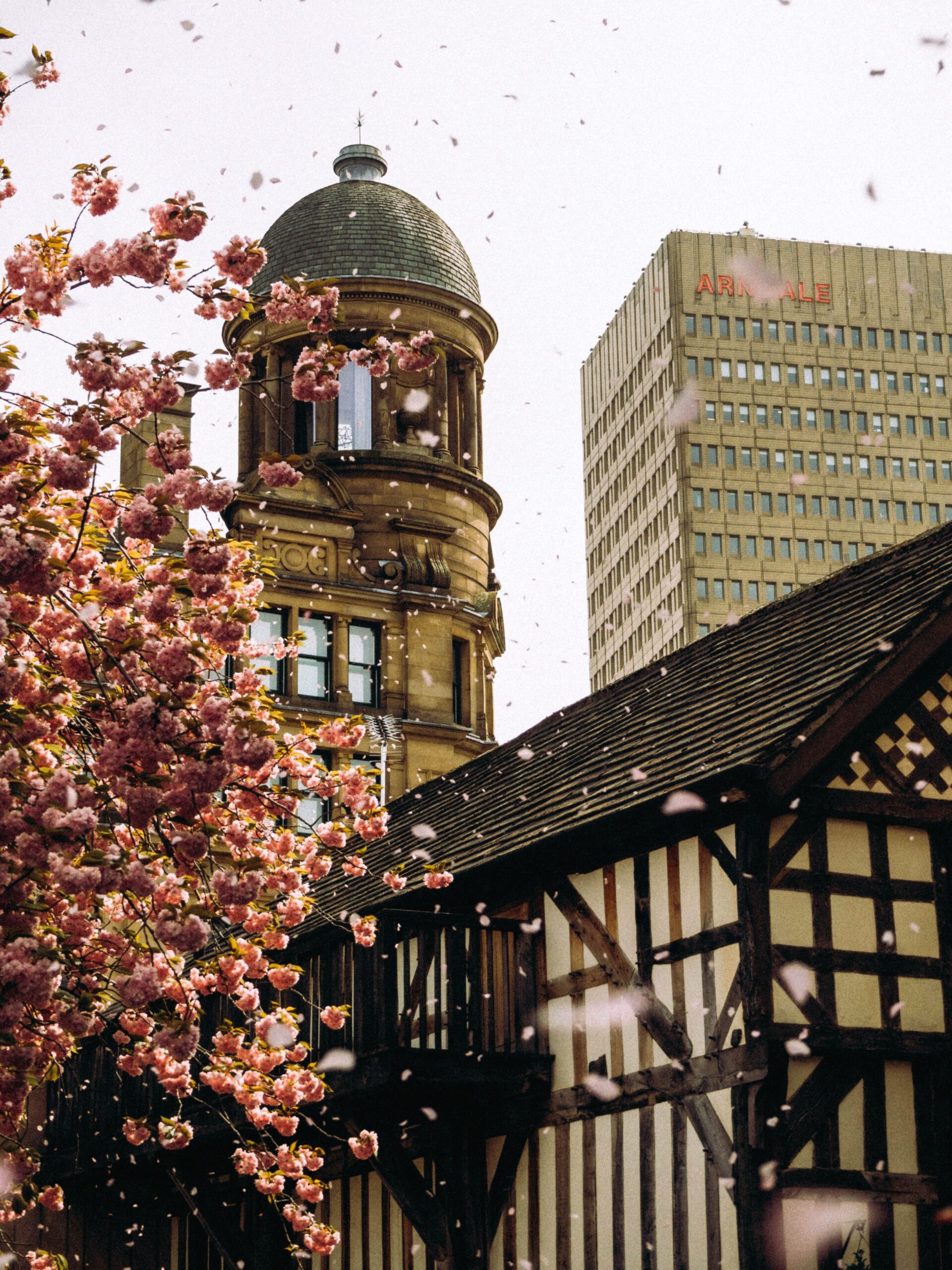
To truly see Manchester, you must look up above the modern shopfronts. The city’s true character is often found in the ornate terracotta carvings, hidden stone mascots, and weathered signage of the upper stories of Victorian buildings. These details tell the story of a city that once had the wealth and the ego to decorate even its most functional warehouses with artistic flourish. When you stop looking at eye level and start observing the rooflines, the layers of the city’s history begin to reveal themselves in a way that no guidebook can replicate.
Manchester does not ask for your approval; it simply exists in a state of constant, restless creation. It is a city where the grit of the industrial past provides the friction necessary for modern sparks to fly. Whether you are drawn to the radical history of its streets or the high-tech future of its laboratories, the artistic rhythm here is authentic, unpretentious, and deeply human. The culture in Manchester is not a static object to be viewed, but a momentum to be joined.
Manage Consent
To provide the best experiences, we use technologies like cookies to store and/or access device information. Consenting to these technologies will allow us to process data such as browsing behavior or unique IDs on this site. Not consenting or withdrawing consent, may adversely affect certain features and functions.
Functional
Always active
The technical storage or access is strictly necessary for the legitimate purpose of enabling the use of a specific service explicitly requested by the subscriber or user, or for the sole purpose of carrying out the transmission of a communication over an electronic communications network.
Preferences
The technical storage or access is necessary for the legitimate purpose of storing preferences that are not requested by the subscriber or user.
Statistics
The technical storage or access that is used exclusively for statistical purposes.The technical storage or access that is used exclusively for anonymous statistical purposes. Without a subpoena, voluntary compliance on the part of your Internet Service Provider, or additional records from a third party, information stored or retrieved for this purpose alone cannot usually be used to identify you.
Marketing
The technical storage or access is required to create user profiles to send advertising, or to track the user on a website or across several websites for similar marketing purposes.